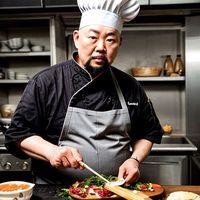
As the ancients said, "Rice and noodles make a couple, while wine and meat bring friends." In May 1990, after officially starting a life full of daily necessities like firewood, rice, oil, salt, soy sauce, vinegar and tea with young Wu, he greatly exceeded my expectations. This man from northern Shaanxi, besides loving wine, meat, friends and social gatherings, also loved cooking. He was proficient in steaming, frying, making rice-based and wheat-based dishes. He was a man of strong will, humorous and straightforward, like a hero on Liangshan Mountain, and also a chef with exquisite skills and unique ingenuity.
Thinking about it carefully, over the past thirty-plus years, our relationship as a couple has been more reflected in the trivialities of three meals a day. His catchphrases when asking me were: "Are you hungry?" "What do you want to eat?" "Shall I cook something for us?"
This man had hearty meals three times a day. Early in the morning, he could steam rice and serve it with four dishes and one soup. Dumplings andhele noodles were commonplace. During festivals, he was even more skilled with his knife. In no time, he could make full use of all kinds of meat, vegetables and eggs at home and lay out a large table full of them. The variety, strange combinations and large quantity were astonishing.
The world of food contains a vast universe, and cooking also hides countless wonders. On the chopping board, the joys and sorrows of life were finely chopped; in the frying pan, the vicissitudes of years were slowly stir-fried. Naturally, his deep love for life was blended into the warmth of every meal and every thread, adjusting our lives among the daily necessities.
Old Wu's temperament was vividly shown when eating and drinking. When friends got together, he was most afraid that others wouldn't drink well. He always took the lead and drank first as an example. If he was lucky enough to meet a bosom friend or a female confidant, he would interpret the connotation and extension of "When wine is in truth, a thousand cups are too few" from theory to practice.
After talking about his love for wine and friends, let's talk about his love for eating and meat. Once there was meat at home, no matter what time it was, he couldn't wait to pick up the knife and start cooking. He would make what he thought was the best delicacy in the world and put it on the table. Then he would "aggressively" ask me to evaluate his cooking skills on the spot. Since we could open our mouths and have hot food, it was really embarrassing to give a bad review.
Even more strict was that, besides not allowing bad reviews, no matter how much you could eat, you had to finish the food cleanly. Leftovers would make him angry. If you dared to pour away the leftover food, it would be like challenging his trigeminal nerve. The torrent of criticism and blame that came your way would make your soul tremble! He would take care of all the leftovers and eat them up. After more than thirty years, I didn't become a fat person, which was a narrow escape.
Old Wu's cooking wasn't a momentary impulse. He had been enjoying it for decades. He was most fond of stewing mutton. Every time, I felt that he put a lot of love into it. From cutting to washing, from blanching to putting it into the pot and adding seasonings, no one else was allowed to approach. Chef Wu enjoyed himself alone, blending the five flavors of life. Not until the aroma of mutton filled every corner of the house did he feel that his task was accomplished. The expression on his face and eyes showed that "Today's mutton has reached my personal highest level". He would call everyone to eat and eagerly wait for everyone's evaluation. You had to answer at least three questions from Chef Wu: Is it fragrant? How fragrant is it? In what way is it fragrant? He would patiently guide everyone to give (high) evaluations of his level.
These three required questions had better be answered in multiple forms such as simile, personification, hyperbole and parallelism. The more specific the praise, the better. After all, it was to highlight the uniqueness, authority and singularity of the chef's level. If you could also munch and give vivid praise while eating, and finish the meat and drink up the soup, I guarantee that you would have the next meal – eat one pot and get one pot free!
I want to expose Chef Wu's exclusive secret here, that is, he incorporated the most unique seasoning – "character" into every home-cooked meal.

By Olivia Reed/Dec 21, 2024
By Lily Simpson/Dec 21, 2024
By Christopher Harris/Dec 21, 2024

By Sarah Davis/Dec 21, 2024

By Emily Johnson/Dec 21, 2024

By James Moore/Dec 21, 2024

By George Bailey/Dec 21, 2024

By Laura Wilson/Dec 21, 2024

By Samuel Cooper/Dec 21, 2024

By Emily Johnson/Dec 21, 2024

By Amanda Phillips/Dec 21, 2024

By Emma Thompson/Dec 21, 2024

By Rebecca Stewart/Dec 21, 2024

By Natalie Campbell/Dec 21, 2024

By Victoria Gonzalez/Dec 21, 2024

By Grace Cox/Dec 21, 2024
By Jessica Lee/Dec 21, 2024

By Ryan Martin/Dec 21, 2024

By Daniel Scott/Dec 21, 2024

By David Anderson/Dec 21, 2024